Written by the Instant Reno Team
You’ve started a kitchen remodel and the budget’s already a worry — now what?
Renovations quickly turn into stress when trades don’t turn up, hidden problems appear, or quotes balloon. If you’re searching for a contractor for kitchen remodel in Marrickville (Sydney Inner West), getting the planning and cost estimation right up front is the difference between a tidy job and a wallet-scorching headache.
Why planning and cost estimation matter
Control over scope and budget: A damp, accurate brief prevents scope creep and nasty variations.
Risk management: Older inner-west homes commonly reveal asbestos, timber rot or non-compliant wiring — you need contingencies.
Faster delivery: With a clear timeline and contract, the job finishes sooner and with fewer disputes.
This guide is practical, Australasian-focused and aimed at people in suburbs like Marrickville, Dulwich Hill, Newtown and surrounding Inner West areas. I’ll walk you through how to pick the right builder, how to estimate costs properly, and what common traps to avoid so you don’t get caught out mid-job.
Local context: Marrickville and the Inner West
Built in stages from the late 1800s through mid-20th century — lots of terraces, fibro cottages and post-war homes.
Common renovation issues: asbestos sheeting in walls/ceilings, old galvanised plumbing, knob-and-tube or outdated wiring, and heritage overlays in pockets that limit external changes.
Council rules and approvals: Inner West Council requires approvals for structural changes, some exterior work and certain fence/driveway changes (check DA requirements if you’re altering the building envelope).
Useful local links
Inner West Council — Building and Renovations overview: https://www.innerwest.nsw.gov.au/development/building-and-renovations
NSW Fair Trading — Home building licences and consumer info: https://www.fairtrading.nsw.gov.au/housing-and-property/building-and-renovating/home-building-licences
SafeWork NSW — Asbestos guidance: https://www.safework.nsw.gov.au/hazards-a-z/asbestos
NSW EPA — Asbestos disposal rules: https://www.epa.nsw.gov.au/your-environment/waste/asbestos
Social proof from the area
People in Marrickville and nearby suburbs on forums and Reddit commonly report: “found asbestos behind kitchen tiling during demolition,” and “variations killed our budget — get a buffer and an itemised contract.” Those sorts of comments pop up regularly, so factor a healthy contingency into your numbers and insist on asbestos testing where the home predates the 1980s.
How to run the project: step-by-step and deep-dive
Step 1 — Define the brief and scope exactly
Decide the outcome: Full gut and relocate services, or a cosmetic refresh (cabinets, benchtop, splashback, paint)?
List must-haves vs nice-to-haves: Appliances, island bench, pantry, redesign of traffic flow.
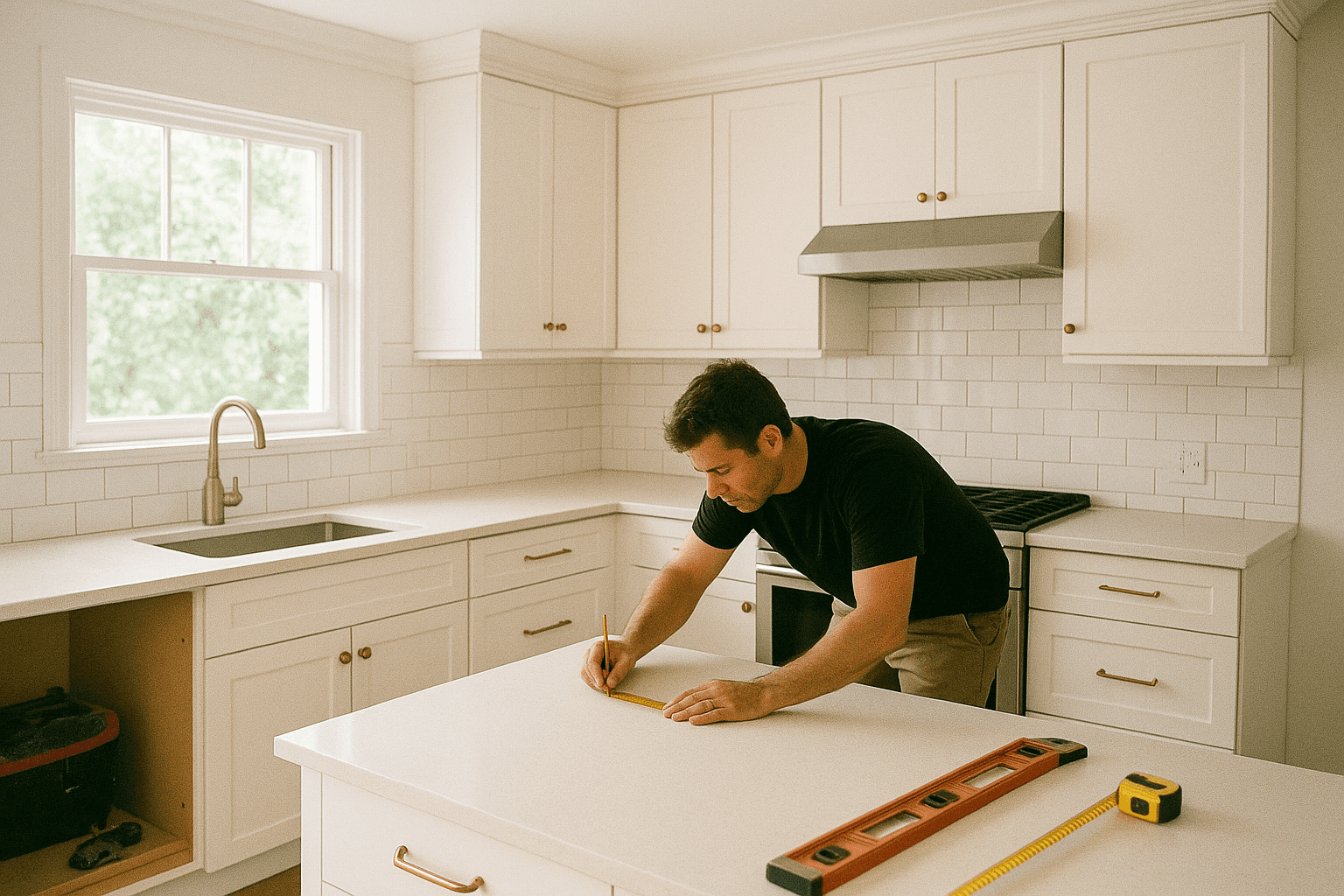
Measure and record: Existing kitchen dimensions, ceiling height, door/window positions and services access.
Take photos and a low-res floor sketch: Contractors appreciate good documentation at the quote stage.
Why this matters: vague briefs produce wildly different quotes — one tradie assumes full removal of walls, another assumes cosmetic. You want apples-to-apples comparisons.
Step 2 — Get the right team
Main contractor / builder: Ideally a licensed builder experienced in kitchen projects. They co-ordinate trades and handle the contract.
Kitchen designer or cabinetmaker: For layouts and cabinetry. Designer fees vary; some contractors include this.
Essential trades: plumber, electrician, carpenter/joiner, tiler, plasterer, painter, appliance installer. Some tasks (bench top templating, stone fitting) are specialist.
Check licences & insurance: NSW — look up licences at NSW Fair Trading. Ensure public liability and home warranty insurance (HBCF) for work over $20k.
How to shortlist contractors
Ask for 3 quotes with the same brief.
Check past jobs in the suburb: request references, photos and, if possible, a local inspection of a finished job.
Read online reviews and local forums for repeated complaints.
Confirm availability and expected start date. A cheap quote 6 months out might be useless.
Step 3 — Contracts, deposits and payments
Written contract: Itemised scope, materials (brands/finish), fixed price vs provisional sums, timeline, start/end dates, variation process, retention, and dispute resolution.
Deposits & progress payments: In NSW, standard practice is a deposit (commonly 10%) then staged progress payments tied to milestones. Never pay large cash sums without a contract.
Variations: All changes must be in writing with price and time impacts.
Home Building Compensation Fund (HBCF): For jobs over $20k, ensure the contractor provides the required home warranty insurance (NSW Fair Trading: https://www.fairtrading.nsw.gov.au/housing-and-property/building-and-renovating/home-building-licences/home-building-compensation-fund).
Estimating the Costs for a contractor for kitchen remodel
Below is a realistic breakdown for kitchens in the Sydney Inner West (AUD, 2025 indicative). Prices vary with finish quality, complexity, and site conditions.
Overall project tiers (fully installed, trades + materials)
Cosmetic / Basic refresh: $8,000 – $22,000
Replace doors & hardware, paint, new splashback, replace tapware and sink, minor electrical.
Typical timeline: 1–2 weeks.
Mid-range remodel: $25,000 – $60,000
New semi-custom cabinets, engineered stone benchtop, new appliances, floor repair/replace, tiling, some plumbing/electrical relocations.
Timeline: 4–8 weeks.
High-end / Full gut & redesign: $60,000 – $150,000+
Structural changes (remove or move walls), custom cabinetry, premium stone (Caesarstone, Marble), integrated appliances, underfloor heating, designer finishes.
Timeline: 8–16+ weeks.
Itemised costs (typical ranges)
Demolition & rubbish removal: $800 – $3,500 (asbestos testing/abatement extra)
Asbestos testing & removal: Testing $200–$400. Removal varies: $2,000–$10,000 depending on extent — organise licensed removal (SafeWork NSW: https://www.safework.nsw.gov.au/hazards-a-z/asbestos).
Cabinetry:
Flatpack or DIY install: $2,500 – $8,000
Semi-custom (modular): $8,000 – $25,000
Custom joinery: $20,000 – $60,000+
Benchtops:
Laminate: $400 – $1,200
Timber / oak: $800 – $3,000
Engineered stone (e.g., Caesarstone): $1,200 – $4,000
Granite / marble: $2,500 – $6,000+
Appliances:
Oven: $400 – $2,000
Cooktop: $300 – $2,500
Rangehood: $250 – $1,500
Dishwasher: $400 – $1,500
Fridge (built-in): $2,000 – $8,000
Sink & tapware: $200 – $1,200
Tiling & splashbacks:
Wall tiling (including adhesive & grout): $50 – $120 per m2 installed
Feature splashback glass: $400 – $1,200
Flooring (if replaced):
Vinyl plank: $40 – $120 per m2
Timber (re-lay or new): $80 – $200 per m2 installed
Tiles: $50 – $150 per m2
Electrical: $1,000 – $6,000 (new circuits, repositioning outlets, lighting)
Plumbing: $1,000 – $5,000 (including moving sink/fixtures)
Plastering & painting: $1,000 – $6,000
Permits & engineer reports: $500 – $3,000 (structural engineer for beams or openings)
Project management / contractor fee: 10% – 20% of total job value (or fixed fee)
GST and contingencies
GST: Most contractors include GST (10%) on materials and labour where applicable — confirm whether quotes are GST-inclusive.
Contingency: Set aside at least 10–20% of the project value for unexpected issues (especially for older homes with asbestos, structural problems or concealed services).
Labour considerations and day rates
Trades day rates in Sydney (indicative): carpenter/joiner $45–$90/hr, licensed plumber $60–$110/hr, electrician $60–$120/hr, tiler $45–$90/hr. These vary by skill and complexity.
Labour % of project: mid-range kitchens often see labour take 30–50% of total project cost.
Timeline expectations
Small refresh: 1–2 weeks
Mid-range: 4–8 weeks
Full gut + structural changes: 8–16+ weeks
Cashflow & holding costs
If you’re displaced temporarily (no functional kitchen), expect extra living costs: eating out, temporary appliances, extra cleaning — budget $500–$1,500 depending on length.
How to compare quotes properly
Ask for itemised quotes with materials specified by brand/grade.
Ask for provisional sums to be clearly noted and priced if possible.
Get clarifications on warranty (trade and product warranties) and who is accountable for faults.
Ensure the quote includes waste removal and site protection.
Step 4 — During construction: manage variations and quality
Hold regular site meetings with the contractor.
Keep a written log of changes and approvals.
Inspect workmanship at key milestones: plumbing rough-in, cabinetry install, benchtop templating, tiling and finishing.
Don’t pay the final invoice until you have a practical completion inspection and defects list.
Common mistakes homeowners make — and how to avoid them
Mistake 1: Choosing solely on price
Problem: Lowest quote often omits important items or uses cheap finishes.
Fix: Compare like-for-like, check references, inspect previous jobs and insist on an itemised contract.
Mistake 2: Not accounting for the hidden stuff
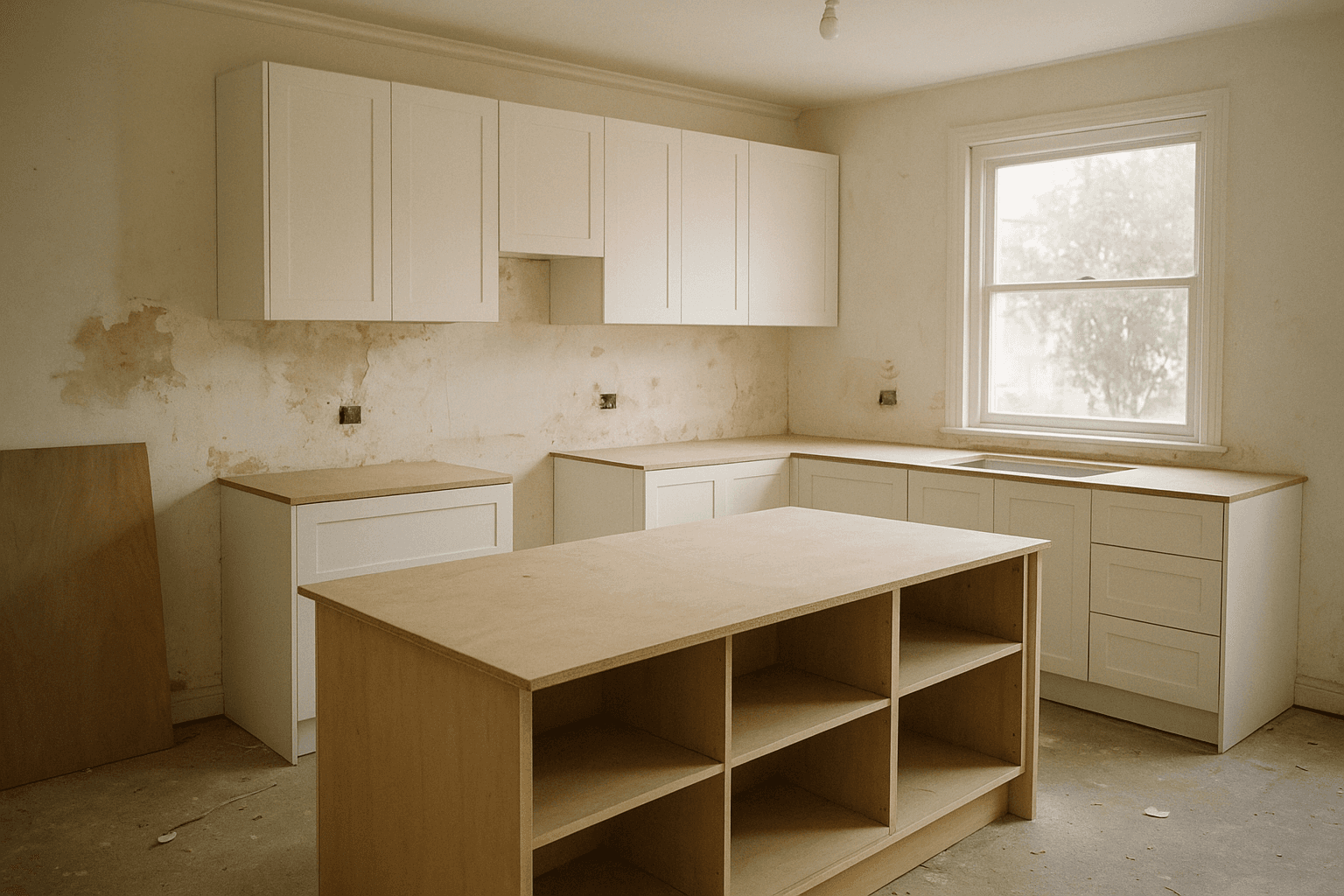
Problem: Asbestos, termites, rot, or old wiring often show up only after demolition. That can blow budgets.
Fix: Pre-demolition inspections (asbestos testing, pest inspections, full electrical/policy report). Factor in a 10–20% contingency.
Mistake 3: Poor communication about finishes
Problem: Buyers assume a matt white door is the same across quotes — it’s not.
Fix: Specify brands, colours, profiles and hardware. Get samples where possible.
Mistake 4: No clear variation process
Problem: Minor ‘extras’ add up fast if there’s no documented variation process.
Fix: Ensure the contract sets how variations are priced and approved (written sign-off on price & time impact).
Cost-saving strategies without cutting corners
Retain layout where possible: Moving plumbing/electrical increases cost significantly.
Use semi-custom or modular cabinetry: Get the look of custom joinery at lower cost.
Mix high and low: Splurge on the benchtop and hardware (where you’ll see long-term benefit), choose practical tiles and taps.
Source wholesale appliances or package deals: Contractors often have trade discounts.
Do some demolition yourself: Only if you know there’s no asbestos and you’re comfortable — otherwise leave it to licensed trades.
Keep structural changes minimal: Cutting out a wall requires structural engineer, council approvals and often a steel beam — big cost.
Red flags when hiring a contractor
No ABN or licence lookup possible on Fair Trading
Requests for unusually large cash payments or no written contract
No proof of insurance (public liability, home warranty)
Vague timelines and an absence of references
Final checklist before you sign
Itemised contract with scope and finishes
Start and completion dates and clauses for delay
Payment schedule with modest deposit (NSW norms)
Evidence of home warranty insurance (if > $20k)
Copies of trade licences and public liability insurance
Asbestos testing and removal plan if property pre-1987
Contact details for the project manager and emergency contacts
Practical tips for Marrickville owners
Expect asbestos risk in many older terraces — arrange testing early (SafeWork NSW and NSW EPA guidance above).
If your property has a heritage overlay, check Inner West Council rules early — you might need Development Approval for visible external changes (https://www.innerwest.nsw.gov.au/live/housing/heritage).
Talk with neighbours if you’ll require scaffolding or extended noisy work — it keeps community tension down.
Closing pitch — what to do next
Get your brief ready: photos, wish list, non-negotiables.
Book two or three licensed local contractors for detailed, itemised quotes.
Ask for references and inspect a finished job if possible.
Keep a 10–20% contingency and never pay the final invoice until you have practical completion and a defects list.
If you want, I can outline a one-page brief template you can send to contractors to get precise, comparable quotes—saves time and helps stop the surprises. Ready for that brief template?
AI-Powered Renovation Expert