Written by the Instant Reno Team
Facing sticker shock for your kitchen? Here's how to stop guessing and get a proper quote
If you’re searching for a reliable contractor for kitchen remodel on the Gold Coast, you’re not alone — kitchen renos are the project where budgets blow out fastest because people underestimate scope. Accurate planning and cost estimation are the difference between a smooth renovation and months of stress, surprise invoices and half-finished cupboards.
This guide explains exactly how to pick the right kitchen renovation contractor, how to interpret quotes and — crucially — how modern photo-based estimation works so you can trust a figure before someone turns up with a tape measure. Whether you live in Surfers Paradise high-rise, a beachfront place in Burleigh Heads, or an older fibro in Southport, you’ll get practical checks, local compliance links and real Gold Coast considerations.
Primary search term used early: contractor for kitchen remodel
What you’ll get in this guide:
A step-by-step process to shortlist and hire a kitchen remodelling contractor on the Gold Coast
A detailed cost breakdown (realistic ranges) for small, mid-range and full gut kitchen remodels
How our photo-analysis process generates reliable estimates from photos and plans
Local issues for Gold Coast suburbs (asbestos risk, coastal corrosion, steep-access charges)
Council and regulatory links you must check (QBCC licensing, council approvals, asbestos rules)
Why accurate planning matters
Reduces surprises: Knowing whether a job is a cosmetic refresh or a structural rework stops scope creep.
Protects your safety and money: Unlicensed trades, hidden asbestos and incorrect plumbing/electrical can cost you tens of thousands and risk insurance claims.
Improves outcomes: A well-planned procurement strategy (cabinet maker, bench supplier, appliance lead times) shortens build time and avoids storage/handling fees.
If you want a stress-free kitchen reno, start with robust quotes and a contractor who backs them up with clear scope, schedule and references.
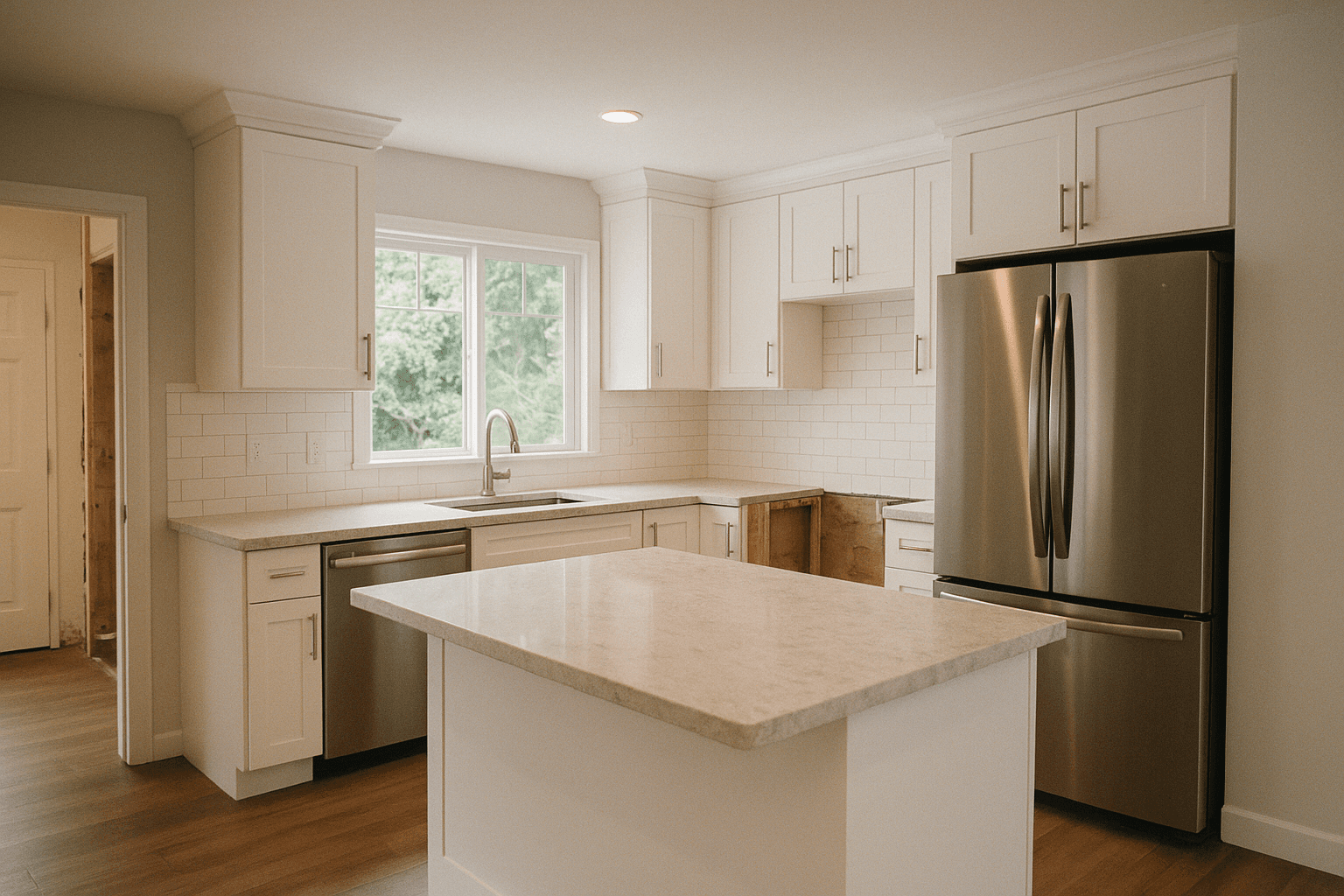
Step-by-step: How to hire the right contractor for kitchen remodel on the Gold Coast
1) Define your scope before you call anyone
Decide your outcome: refresh (cabinet doors, benchtop, splashback), partial reconfigure (move sink or oven), or full gut (new layout, structural changes).
List fixed items: appliance models you want, benchtop material, sink and tap, floor finish. These choices determine plumbing and electrical work.
Take photographs and rough sketches: provide contractor photos of every wall, joinery, ceiling and services. This accelerates accurate quotes.
2) Shortlist contractors and check licences
Require a QBCC licence for any work involving structural, plumbing or electrical trades: verify at https://www.qbcc.qld.gov.au
Ask for: ABN, insurance certificates (public liability, contract works), references and recent portfolio images.
Get at least three quotes from: dedicated kitchen fit-out contractors, a licensed builder or a reputable local carpentry/joinery business.
3) Compare quotes properly (not just price)
When you receive a quote, compare these items line by line:
Scope clarity: Does it list demo, plumbing, electrical, cabinetry, benchtops, splashback, tiling, paint and clean-up? Vagueness = variation risk.
Materials specified: brand and thickness of benchtop, cabinet carcass construction (Plywood vs MDF), soft-close hardware, splashback type.
Inclusions/exclusions: appliance supply? Backsplash tiling? Appliance installers? Permit fees?
Schedule: start date, milestone dates and completion window.
Payment terms: deposit, progress payments tied to clear milestones, holdback for defects period.
4) Use photo-based estimates to qualify quotes before site visit
Modern photo-analysis and measurement technology lets experienced contractors provide a reliable estimate before a site inspection. Here’s exactly how our photo-estimate process works so you can understand the number you’re given:
Step 1 — Photo quality check: we require a set of clear photos — one of each wall, ceiling, floor, services (meter box, water stopcock), and wide-angle shots showing room context. Poor photos trigger a request for better images.
Step 2 — Scale & reference detection: the image engine identifies reference items with known sizes (standard door = 820mm, power points, tiles or an appliance) to estimate scale. Where possible, you’ll be asked to include a tape or A4 sheet for accurate scaling.
Step 3 — Layout recognition: algorithms detect cabinetry runs, island footprints, appliance locations, wall thickness and openings. This creates a measured floor plan (estimated) and elevation sketches.
Step 4 — Condition and material identification: surface textures, existing benchtop finishes, tile patterns and presence of plasterboard vs fibro are analysed to classify work type (replace, repair, or cosmetic refinish).
Step 5 — Service mapping: visible plumbing fixtures, electrical switchboards and rangehood ducting are identified. If services are hidden, the estimate flags a contingency and recommends site inspection.
Step 6 — Risk & access screening: driveway slope, stair access and parking are assessed from images to identify crane or hoist needs for heavy benchtops or appliances — these add direct costs.
Step 7 — Localised cost application: the system applies Gold Coast region labour rates, supplier prices and waste disposal fees (including licensed asbestos removal contingencies if fibro is detected or the house age suggests risk).
Step 8 — Quote generation: the estimate is presented with a confidence score and flagged items that require on-site confirmation (structural wall changes, concealed water damage, asbestos suspicion).
This photo-based approach lets you get a realistic price range quickly and helps weed out lowball quotes that later inflate via variations. It is not a replacement for a final on-site measure when structural or concealed services work is required — it’s a fast qualification tool.
5) Understand typical cost breakdowns for Gold Coast kitchens
Note: all figures are approximate ranges for 2025–2026 Gold Coast market conditions. Costs vary by finish choices, site access and whether you use custom joinery.
Small refresh (re-spray doors, new handles, benchtop laminate): $8,000–$20,000
Cabinet doors re-spray or replacement: $2,500–$8,000
Laminate benchtop: $1,500–$4,000
New sink/tap & fittings: $300–$1,200
Labour & minor electrical/plumbing: $1,500–$4,000
Mid-range remodelling (new carcasses, engineered stone benchtop, new appliances): $20,000–$45,000
Semi-custom joinery: $8,000–$15,000
Engineered stone benchtop (incl. templating & install): $3,500–$8,500
Appliances (mid-range pack): $3,000–$8,000
Trades (plumber, electrician, tiler): $3,000–$6,000
Full gut + layout change (structural work, relocate services, high-end finishes): $45,000–$120,000+
Structural alterations and council approvals: $5,000–$25,000
Custom joinery & luxury benchtop: $20,000–$50,000+
High-end appliances & services: $8,000–$25,000
Contingency (hidden issues, 10–20%): add to above
6) Local Gold Coast considerations that change cost
Beachfront corrosion: use marine-grade stainless fixings, powdercoated hardware and corrosion-resistant ventilation. Expect 5–15% premium on materials in beachfront suburbs like Main Beach or Burleigh Heads.
Asbestos risk in older homes: many Gold Coast suburbs built pre-1987 may have fibro sheeting. Licensed asbestos removal is mandatory — this adds $1,500–$8,000 depending on area and complexity (see QLD guidance: https://www.qld.gov.au/environment/pollution/management/waste/priority-waste/contaminants/asbestos).
Access and crane needs: narrow laneways or elevated homes (Mt Tamborine, Nerang hills) may require crane hire for stone benchtops or large appliances — typically $900–$2,500 per lift.
Flood and stormwater overlays: check City of Gold Coast flood maps — works in flood-affected zones may require special approvals and flood-compliant designs (https://www.goldcoast.qld.gov.au/flooding-and-drainage).
Heritage overlays: some pockets of the Gold Coast have heritage considerations; any change to protected fabric requires council approval (https://www.goldcoast.qld.gov.au/council/regulations-plans/heritage).
7) Permissions and compliance — what needs approval?
No approvals needed: cosmetic work that does not affect structure or services (cabinet door replacement, painting) generally doesn't need council approval.
Approvals likely required: moving plumbing waste lines, altering structural walls, new windows/doors, or changing floor levels. Check City of Gold Coast guidance here: https://www.goldcoast.qld.gov.au/building-renovating and QBCC for licensing rules at https://www.qbcc.qld.gov.au
Asbestos removal: must be handled by licensed asbestos removalists; check QLD asbestos rules at https://www.qld.gov.au/environment/pollution/management/waste/priority-waste/contaminants/asbestos
8) Finalise contract and quality checks
Detailed written contract: scope, materials list (brands/models), timeframes, payment schedule and defects liability period.
Holdback clause: keep a small retention (eg. 5–10%) until final snagging is complete.
Progress photos and site reports: require regular updates and sign-off at milestones.
Warranties: get manufacturer warranties for appliances and stone, and ask your contractor for workmanship warranty (usually 12 months minimum).

Common mistakes Gold Coast homeowners make — and how to avoid them
Mistake 1 — Choosing the cheapest contractor
Why it fails: low quotes often cut corners on materials, use unlicensed subcontractors, or leave out critical items (appliance installation, ducting, appliance rebates).
Fix: compare full scopes, confirm licences (QBCC) and insurance, and ask for recent references from similar Gold Coast jobs.
Mistake 2 — Not allowing contingencies for hidden problems
Common hidden issues: termite damage behind cupboards, old electrical wiring that must be upgraded, water damage within floors, and asbestos in fibro that requires removal.
Fix: budget a 10–20% contingency. Use the photo-estimate confidence score — if the estimate flags unknowns, prioritise an on-site inspection before deposits.
Mistake 3 — Over-customising early, under-scheduling lead times
Why it hurts: custom joinery and stone benchtops have long lead times (4–12 weeks). Changing finishes mid-job causes cost and time blowouts.
Fix: lock in selections early, place long-lead-item orders on an agreed timeline, and include supply lead times in your contract.
Mistake 4 — Ignoring local coastal conditions
Issue: cheap hardware and non-marine screws corrode quickly in beachside homes.
Fix: specify marine-grade fixings and ventilation solutions. Accept a small premium for longevity — cheaper to do it right than repeat work in 3–5 years.
Money-saving strategies without cutting corners
Keep layout the same: moving plumbing and walls is expensive. A layout-retention refresh saves substantial labour and approvals costs.
Mix custom and modular: use custom joinery for focal areas (island, appliances) and modular units for less visible runs.
Buy appliances in a package: retailers often offer discounts for full kitchen appliance packs and may include delivery and installation.
Source finishes smartly: substitute a high-end area (stone island) with a quality laminate on less visible runs.
Phased approach: if budget is tight, prioritise essentials (stove, oven, sink) and plan cosmetic updates later.
Red flags when hiring a contractor
Unwilling to provide a QBCC licence number or proof of insurance. Always verify licences at https://www.qbcc.qld.gov.au.
Demanding large upfront cash deposits above 20–30%. Reasonable deposit is typically 10–30% depending on work and materials ordered.
Vague scope documents and handshake deals. If they can’t write a clear scope, don’t proceed.
No fixed timeframe or refusal to provide a schedule. Time on-site is money; lack of schedule signals poor organisation.
Gold Coast-specific social proof and local homeowner feedback
People on Gold Coast community forums and renovation threads have repeatedly flagged the importance of licensed trades and asbestos checks. Typical community feedback includes comments like:
"We hired a local joiner who was cheaper but they used cheap hardware — had to redo everything within two years."
"Get photos to every tradie first — it saved us heaps because a fitter told us the stone would need a crane and one didn’t."
"If your place was built in the 70s or earlier, get an asbestos check — it’s not worth the risk."
This consensus across local threads highlights why pre-quote photo analysis and licence checks matter.
Final checklist before you sign
Verify QBCC licence and insurances
Confirm material brands and models in the contract
Ensure the quote includes remove and dispose items (and asbestos removal if relevant)
Agree a payment schedule tied to milestones
Check for council approval requirements and include responsibility for lodgement in the contract
Get an agreed defects liability period and holdback
Useful links for Gold Coast renovators
City of Gold Coast — Building & Renovating: https://www.goldcoast.qld.gov.au/building-renovating
City of Gold Coast — Heritage information: https://www.goldcoast.qld.gov.au/council/regulations-plans/heritage
Queensland Government — Asbestos information and removal: https://www.qld.gov.au/environment/pollution/management/waste/priority-waste/contaminants/asbestos
Queensland Building & Construction Commission (QBCC) — check licences: https://www.qbcc.qld.gov.au
Gold Coast flood and drainage guidance: https://www.goldcoast.qld.gov.au/flooding-and-drainage
If you’d like, I can review photos of your kitchen and produce a free pre-quote estimate using the photo-based process described above. That pre-quote will list items needing on-site confirmation, typical cost ranges for your Gold Coast suburb and likely permits — a fast way to separate realistic contractors from guesswork.
AI-Powered Renovation Expert